As the Winter Games broaden, debutants such as Benin, Guinea-Bissau and the UAE open longshot betting avenues in alpine events—punters might place small outright or novelty bets on these storylines but should favor established medal powers (Norway, USA, Germany) for futures. Expect value in novelty props and underdog markets rather than win-or-medal markets for debut athletes.
Winter Olympics expanding beyond cold‑weather strongholds
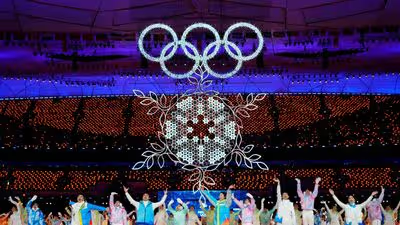
The Winter Olympics Games have long been dominated by cold‑climate nations, but the field headed to Milan‑Cortina shows incremental diversification. After peaking at 91 delegations in Beijing 2022, the 2026 event is currently expected to include about 86 delegations, not counting Individual Neutral Athletes from Belarus and Russia who meet eligibility conditions.
From Chamonix to Milan: growth of an international field
When the Winter Olympics began in Chamonix in 1924, only 16 countries participated. Nearly a century later, the Games are far larger and attract delegations from across continents, though participation still heavily favors countries with winter infrastructure. The IOC’s ongoing efforts to broaden access have driven a slow but steady increase in representation from warmer regions.
Medal table: traditional powers still rule
European nations occupy eight of the top 10 all‑time spots on the Winter Olympic medal table, led by Norway — a powerhouse despite its small population. The United States and Canada are the two non‑European nations among the top 10. Outside Europe and North America, only a handful of hosts and well‑funded programs such as China, Japan and South Korea break into the top 25.
Where medals are concentrated
Success outside the traditional cold‑weather bloc is limited. Australia has enjoyed isolated success in freestyle skiing and snowboarding; Kazakhstan, New Zealand and a few others have occasional podiums. Africa and much of Latin America still search for their first Winter Olympic medals, even as nations like Argentina, Brazil, Mexico, Morocco and Nigeria plan to send athletes.
Qualification, quotas and how newcomers gain entry
Each sport sets its own qualification pathway: hockey leans on world rankings and qualification tournaments, curling uses recent world‑championship results plus qualifiers, alpine skiing relies on World Cup points and national quotas, and sliding sports assign Olympic qualification events. Quotas are used to balance competition and help smaller or nontraditional winter nations send athletes.
Quota impact: opening doors
Quotas and targeted qualification rules are key to growing global participation. They create pathways for athletes from countries without deep winter systems to compete on the Olympic stage, often in limited numbers and specific events.
Debut nations and human‑interest storylines
Several countries will make Winter Olympic debuts, with alpine skiers representing Benin, Guinea‑Bissau and the United Arab Emirates among the newcomers. These athletes’ personal stories — including training abroad and unconventional paths into skiing — generate media attention and national pride, and they often become focal points for broader Olympic coverage.
What to watch from debutants
Debut athletes rarely contend for medals, but they can influence event narratives and attract attention in feature events. Their presence boosts diversity and provides fresh angles for broadcasters and fans.
Barriers to broader participation
The primary obstacle to wider Winter Olympic representation is climate and infrastructure. More than 40% of National Olympic Committees have never sent athletes to the Winter Games. Some territories that compete in certain international federations still lack IOC recognition, which prevents them from entering under their own flag.
Betting implications: where value may lie
For bettors, the expansion of the field shifts market dynamics.
Established nations remain the safest choices for medal and overall futures. Newcomers create value in novelty markets: small outright wagers, appearance props, or human‑interest futures can yield upside without displacing favorites.
Italy's Nicol Delago leading World Cup downhill with Lindsey Vonn 3rd
Expect bookmakers to offer more underdog and storyteller markets around debut athletes, while traditional markets stay concentrated on Norway, the U.S., Germany and other proven programs.
A huge multinational delegation will gather in Italy in February.
 Si
Si