
Vitor Galvani’s Mexico City Capitanes borrow Guardiola-style principles—high press, aggressive turnovers and short rotations—creating fast, disruptive games. Punters might back the Capitanes to force steals/turnovers, consider player prop bets on steals and live-market swings, or favor higher game totals when both teams deploy transition-heavy tactics.
From Guardiola to the Hardwood: Vitor Galvani’s Tactical Blueprint
Vitor Galvani, head coach of Capitanes in the NBA G League, has openly mapped parts of his coaching identity to soccer influences, citing Pep Guardiola’s team-first philosophy and high-possession strategies. The Capitanes’ head coach blends those ideas with lessons from Brazilian and European soccer to shape a basketball system built on constant attacking and collective control rather than individual heroics.
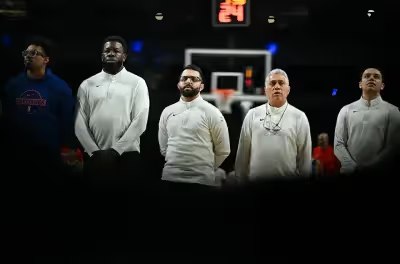
Soccer-inspired principles shaping basketball strategy
Galvani traces his inspiration to soccer managers who prioritized structure, short passing and integrated phases of play. He says those concepts translated into basketball as an emphasis on team cohesion, off-ball movement and designing possessions where scoring is the product of controlled, repeatable processes rather than chance.
Pressing, Turnovers and Transition: The Capitanes’ Identity
One clear adoption is the aggressive defensive approach. The Capitanes press more than most teams, looking to force turnovers and convert them into quick transition scores. That disruption mentality has yielded a high turnover-forcing rate and sustained the team’s capacity to create offense off defense.
How pressing alters rotations and workload
To sustain a relentless, high-effort style, Galvani relies on a broad rotation: typically nine or ten players with short stints. He argues that with the intensity demanded, longer minutes are unsustainable. This FIBA-influenced substitution pattern means fresh legs on every possession, enabling the Capitanes to maintain pressure without collapsing late from fatigue.
Adapting Systems to Personnel, Not Copying Wholesale
Galvani stresses adaptability: he won’t force a warrior-style or Golden State system without the matching roster. Instead, he tailors schemes to his players’ strengths, keeping core principles—pressing, quick offense, effort-based defense—while adjusting specifics to available talent and limited practice time.
Practice time and tactical compromises
Limited practice minutes have tempered some of Galvani’s more elaborate experiments, such as sustained offensive-crash-then-press sequences. Still, the Capitanes preserve the disruptive DNA: they prioritize turnovers and quick conversion opportunities even if the full system must be simplified for execution.
Comparisons to the Celtics’ Approach
There are philosophical parallels with other successful teams, including Boston’s emphasis on adaptability and depth usage. Both programs value short, intense rotation bursts and a blend of pressing and structured offense, illustrating how cross-sport and cross-league ideas are influencing modern coaching across the basketball world.
FIBA rotations and NBA context
Galvani’s FIBA background informs his rotation philosophy: micro-stints and frequent substitutions to maximize intensity. In an NBA-influenced environment where minute loads and star usage differ, that FIBA approach stands out and offers a tactical alternative that can produce disruptive advantages, particularly against teams unaccustomed to such sustained pressure.
The Player-Level Impact: Roles and Expectations
Players are given clear responsibilities to “empty the tank” on every possession, with effort and team discipline prioritized. This creates a culture where defensive gambling for steals and aggressive pursuit of offensive rebounds are institutionalized actions rather than occasional gambits.
How this affects matchup planning
Opponents must prepare for short, intense bursts and constant pressure, adjusting substitution patterns and ball-security strategies. Teams that handle pressure and win the turnover battle can neutralize the Capitanes’ edge, while those that falter often see the game tilt quickly in Mexico City’s favor.
What this means for the league and game trends
Galvani’s influence highlights a broader trend: coaches borrowing across sports and systems to innovate. The growing exchange of ideas is making the league more varied tactically, with pressing, transition emphasis and flexible rotations becoming increasingly common tools for teams seeking an edge.
Outlook for the Capitanes
If Galvani continues to refine his system around personnel constraints and practice realities, the Capitanes will remain a disruptive, fast-paced team that can upend expectations. Their success will hinge on executing pressure consistently and keeping personnel fresh enough to maintain intensity across games.
Ja Morant putting best foot forward a must if he's going to get out of Memphis
It's not just Boston Celtics head coach Joe Mazzulla who has found inspiration in soccer. Nor in famed soccer manager Pep Guardiola, for that matter.
 Yahoo! News


