


The IOC’s secret-ballot host selections — from Milan-Cortina 2026 to Salt Lake City 2034 — shift national investment and medal projections. For bettors, this typically means backing host-nation athletes in sports where home advantage is strongest (alpine skiing, figure skating, snow sports) and reassessing futures on national medal totals and event props as host selections alter odds and funding cycles.
How the IOC Chooses Olympic Hosts: The Voting Process Explained
Members of the International Olympic Committee (IOC) select Olympic host cities by secret ballot, one vote per active member. If no candidate wins a majority in the first round, the city with the fewest votes is eliminated and additional rounds are held until a candidate secures a majority. This method has shaped the modern Olympic calendar and long-term planning for hosts and competitors alike.
Confirmed and Upcoming Hosts (2024–2034)
Near-term confirmed hosts
2024 — Paris, France
2026 — Milan and Cortina d'Ampezzo, Italy
2028 — (not listed)
2030 — French Alps (Winter)
2032 — Brisbane, Australia
2034 — Salt Lake City, Utah, United States
Why Host Selection Matters for Sport and Betting
Host cities drive infrastructure spending, athlete development and crowd support — factors that translate into competitive advantages. National teams often see improved preparation and larger medal hauls at home, affecting futures and prop markets. Sports bettors should monitor host announcements closely: markets for host-nation medal totals, event winners in venue-favored disciplines, and odds on national team performance typically adjust as hosts commit resources and athletes gain home-field benefits.
Practical betting takeaways
- Back host-country contenders in venue-favored sports (e.g., winter hosts boost alpine and skating prospects). - Reevaluate national medal futures after official host confirmations and as test-event results emerge. - Watch for market movement tied to host investments, team selection changes and pre-Games results.
Historical Hosts: A Century of Olympic Destinations
1896 — Athens, Greece
1900 — Paris, France
1904 — St. Louis, Missouri, United States
1908 — London, England
1912 — Stockholm, Sweden
1916 — Cancelled (World War I)
1920 — Antwerp, Belgium
1924 — Paris and Chamonix, France
1928 — Amsterdam; St. Moritz, Switzerland
1932 — Los Angeles; Lake Placid, United States
1936 — Berlin; Garmisch-Partenkirchen, Germany
1940 — Cancelled (World War II)
1944 — Cancelled (World War II)
1948 — London; St. Moritz, Switzerland
1952 — Helsinki; Oslo, Finland/Norway
1956 — Melbourne; Cortina d'Ampezzo, Italy
1960 — Rome; Squaw Valley, United States
1964 — Tokyo; Innsbruck, Austria
1968 — Mexico City; Grenoble, France
1972 — Munich; Sapporo, Japan
1976 — Montreal; Innsbruck, Austria
1980 — Moscow; Lake Placid, United States
1984 — Los Angeles; Sarajevo, Yugoslavia
1988 — Seoul; Calgary, Canada
1992 — Barcelona; Albertville, France
1994 — Lillehammer, Norway
1996 — Atlanta, United States
1998 — Nagano, Japan
2000 — Sydney, Australia
2002 — Salt Lake City, United States
2004 — Athens, Greece
2006 — Turin, Italy
2008 — Beijing, China
2010 — Vancouver, Canada
2012 — London, England
2014 — Sochi, Russia
2016 — Rio de Janeiro, Brazil
2018 — Pyongyang, North Korea
2020 — Tokyo, Japan
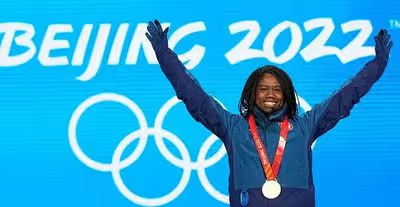
2022 — Beijing, China
Final note for punters
Host-city announcements are more than calendar entries: they are signals of shifting competitive landscapes. Use them to adjust futures, target event-specific props, and capitalize on home-nation momentum as funding, facilities and crowd advantage begin to shape the odds.
Canucks’ Blueger preparing for Olympics and possible trade after return
Check out which cities have received the honor to host the Summer and Winter Olympics.
 Espn
Espn


