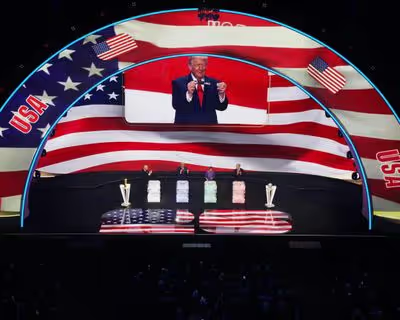
The United States’ role as a 2026 World Cup co-host is under pressure after recent federal violence and policy controversies. For bettors, this creates volatility: futures and markets tied to the U.S. hosting or team performance could see odds shift or suspension, while prudent punters may avoid U.S.-based match markets and favour neutral or contingency bets on relocations or boycotts.
2026 World Cup Hosting in Doubt as Federal Violence Sparks Security Concerns
The prospect of the United States co-hosting the 2026 World Cup has moved from excitement to acute unease. Recent incidents of federal violence and contentious immigration enforcement have raised questions about safety, justice and whether the country can credibly welcome millions of international fans.
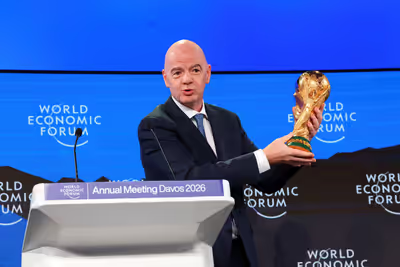
Fan Experience and Local Impact at Risk
Cities, businesses and supporters who planned around the economic and cultural windfall of hosting matches face potential losses. Exorbitant ticket prices, heavy public expenditures on infrastructure and security, and the alienation of grassroots supporters have already dented enthusiasm. Moving or cancelling matches would create logistical chaos and significant financial disruption.
Federal Violence and Public Trust
The killings of two unarmed civilians in Minneapolis by federal agents, captured on video and widely circulated, have intensified scrutiny. Official statements branding the victims as threats conflict with available evidence and have eroded public trust. Broader enforcement actions have seen a rise in detentions and deaths in custody, concentrating operations in Democratic-leaning metros—areas that include most U.S. host cities.
Political Context and International Perception
The administration’s confrontational foreign and domestic posture—ranging from high-profile diplomatic disputes to aggressive immigration crackdowns—has created diplomatic friction and raised doubts about the U.S.’s suitability as an international showcase. FIFA’s messaging about football as a unifying force sits uneasily next to a host nation perceived as increasingly divisive.
FIFA, Boycott Talk and the Realities of Reconfiguration
Talk of boycotts and match relocations has surfaced. A sufficient band of national teams refusing to participate in U.S. venues could force FIFA’s hand. Yet a boycott would cost massive revenue and present near-impossible scheduling challenges. At the sport’s leadership level there’s confidence football will outlast political regimes, but practical consequences for the 2026 event remain serious.
Statements from Football Leaders and Government Risks
Football administrators have voiced faith that the sport transcends politics, but realpolitik matters. Comments suggesting matches could be moved from deemed-unsafe cities hint at potential internal shifts rather than removal of the U.S. as co-host. Still, the optics of hosting under these conditions undermine organisers’ assurances about safety and hospitality.
Betting Implications and Market Volatility
The uncertainty around venues, participation, and public safety will likely ripple through betting markets. Futures tied to the U.S. hosting full fixtures, ticket-dependent markets, and merchandise-driven lines may see odds altered or markets suspended. Punters should expect increased volatility, wider spreads, and added value in contingency markets—such as odds on match relocations, boycotts, or adjusted tournament formats. Hedging and limiting exposure to U.S.-based match markets will be prudent.
Conclusion: Football’s Showcase Under Strain
The World Cup’s staging in the United States was meant to be a crowning moment for domestic soccer growth. Instead, a combination of high costs, governance concerns and recent federal actions has placed that promise in jeopardy. For sport and society alike, the coming months will test whether football’s global appeal can withstand a host nation’s deep political and security challenges.
A country where safety is under threat from federal violence on the streets is not fit to stage soccer’s showpiece event. Removing the United States as co-host of the 2026 World Cup would hurt for pretty much everyone. Fans would miss out on seeing the sport’s pinnacle in their home towns (or somewhere nearby).
Cities and businesses small and large would lose the financial benefits they had banked on. It would be a logistical and political nightmare on an international scale, the likes of which have never been seen before in sports. It would be eminently sad. And it would be entirely justified. It brings me no pleasure to say this. The United States has been eager to host a men’s World Cup for more than a decade and a half.
The desire survived and even grew after 2010s failure to out-bid Russia and Qatar (in public and behind closed doors) for the 2018 and 2022 World Cups. With hosting rights for 2026 later secured alongside Canada and Mexico, the US soccer scene prepared to show off that the sport is now part of the nation’s fabric, 32 years after hosting the tournament for the first time in 1994.
Soccer’s growing popularity in America has helped inspire other US sports to try new formats, encouraged us to engage more fully with the world in a sporting context, and has been at the centre of conversations about our society and culture.
England fans' World Cup arrest record shows Infantino joke inaccurate
The 2026 World Cup was seen as the best chance for the world to fully experience not just how much the US has improved at soccer, but how much soccer has improved the US. Continue reading...
 The Guardian